
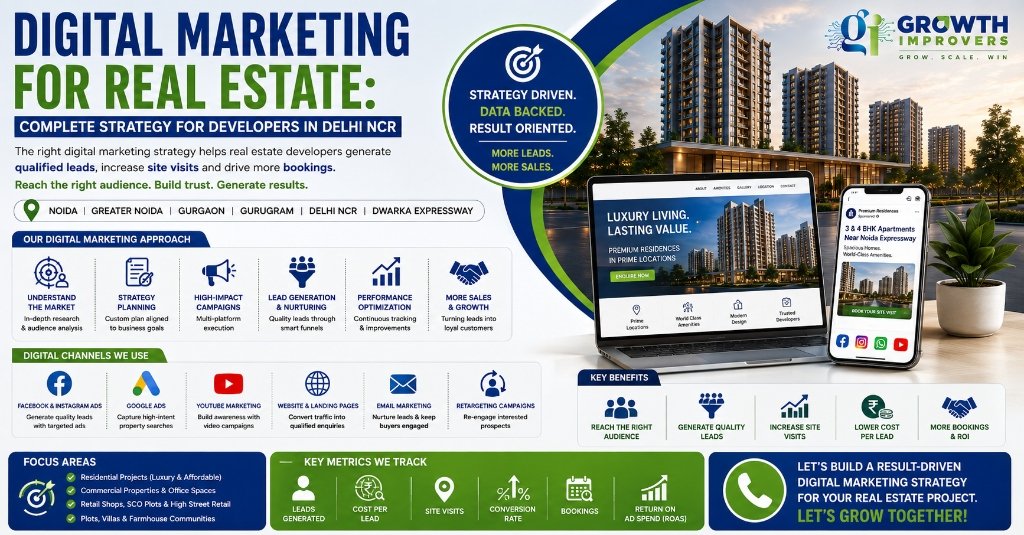
Selling real estate has changed dramatically. A few years ago, property businesses could depend heavily on newspaper advertisements, outdoor hoardings, property exhibitions, brokers, and referrals to generate enquiries.
Those channels still have a role, but today's property buyer often begins the journey online. A buyer may discover a project on Instagram, search for the developer on Google, compare prices on property portals, watch a project walkthrough video, read reviews, visit the website, and only then speak with a salesperson.
This has made digital marketing for real estate an essential part of modern property sales. But digital marketing does not simply mean running Facebook Ads or publishing posts on Instagram.
"A successful real estate marketing strategy connects multiple activities into a unified engine: Search + Paid Advertising + Content + Website + Dedicated Landing Pages + Lead Generation + CRM Integration + Rapid Sales Follow-Up."
When these elements work together, a developer creates a measurable, predictable, and scalable system for attracting genuine property buyers. For businesses operating in Noida, Greater Noida, Gurgaon, Gurugram, Delhi NCR, and Dwarka Expressway, this integrated approach is particularly critical because the market is intensely competitive and buyers have dozens of alternative projects to compare.
Why Real Estate Businesses Need Digital Marketing
Buying a property is rarely an impulse decision. A prospective home buyer or commercial investor may spend weeks or months researching before committing their savings.
During this extended consideration window, buyers actively search for:
- Property prices & price trends across specific sectors
- Best micro-locations with upcoming infrastructure
- Developer credibility, track record, and delivery history
- Real buyer project reviews and construction updates
- Detailed 3D floor plans and carpet area transparency
- Clubhouse amenities, parking ratios, and green spaces
- RERA registration compliance and legal clarity
- Flexible payment plans and possession timelines
This creates multiple digital touchpoints where a real estate brand must establish presence. A developer that appears only when the buyer is finally ready to submit a contact form will lose countless opportunities to competitors who nurtured the buyer across earlier research stages.
The 7-Stage Modern Real Estate Buyer Journey
Effective performance marketing mirrors the real decision-making psychology of high-ticket property buyers through seven distinct stages:
Stage 1: Awareness & Discovery
The buyer encounters the project for the first time through Meta Ads (Instagram/Facebook Reels), Google Display banners, or YouTube video walkthroughs. At this stage, the buyer is not ready to book; the goal is brand recall, aesthetic appeal, and curiosity.
Stage 2: Active Research
The buyer conducts active Google searches for the project name, developer reputation, exact sector connectivity, and nearby infrastructure. High-intent Google Search campaigns, optimized landing pages, and educational content are paramount here.
Stage 3: Project Comparison
The buyer weighs 2 to 4 competing projects: Which developer has stronger delivery credibility? Which layout offers better usable space? Which pricing represents real value? Clear positioning and USP differentiation win at this stage.
Stage 4: Enquiry & Lead Capture
The buyer requests a brochure, pricing sheet, or private site visit walkthrough. This interaction creates an identifiable, measurable lead with captured contact details.
Stage 5: Sales Conversation & Qualification
The developer's sales team contacts the lead within minutes to verify budget, configuration needs (3 BHK vs 4 BHK), purchase timeframe, and buying intent (end-user vs investor).
Stage 6: Physical Site Visit Walkthrough
The qualified prospect visits the sample flat, experience centre, or construction site. This represents the single highest-value milestone in the property sales pipeline.
Stage 7: Booking & Transaction
Unit selection, payment schedule agreement, and legal token booking. A professional agency evaluates campaigns across this entire funnel—not merely on the initial cost per lead.
The Core Components of a Real Estate Digital Strategy
An integrated performance marketing engine unites six core disciplines to drive continuous, qualified pipeline:
1. Search Engine Optimisation (SEO) for Real Estate
SEO builds sustainable organic visibility for high-value search queries without ongoing cost-per-click charges. Key keyword clusters include:
- Location Keywords: "Property in Noida", "Flats in Gurgaon", "Apartments near Dwarka Expressway"
- Configuration & Asset Keywords: "Luxury 3 BHK apartments", "4 BHK penthouse", "Commercial retail shops", "SCO plots"
- Agency & B2B Service Keywords: "Real estate digital marketing agency", "Property lead generation company Delhi NCR"
2. High-Intent Google Search Ads
A user typing "4 BHK luxury apartments in Gurgaon Golf Course Extension" possesses immediate, high-intent commercial demand. Unlike passive social media scrolling, Google Search Ads captures buyers actively searching for inventory.
3. Meta Ads (Facebook & Instagram)
Real estate is inherently visual and aspirational. Meta Ads introduces properties through high-resolution architectural renders, cinematic drone footage reels, carousel floor plans, and interactive Instant Lead Forms.
4. Conversion-Focused Landing Pages
Sending paid ad traffic to a generic corporate homepage destroys conversion rates. A dedicated project landing page aligns precisely with the advertisement copy, loading in under 2 seconds with transparent price breakdowns, 3D views, and instant WhatsApp triggers.
5. Content Marketing & Topical Authority
Publishing comprehensive corridor buying guides, payment plan breakdowns, and market analyses establishes the developer as a trustworthy market authority rather than just another commercial advertiser.
6. Local SEO & Google Business Profile
Optimizing Google Business Profiles, managing verified buyer reviews, and maintaining accurate location citations ensures prime visibility on Google Maps and local pack searches.
Micro-Market Strategies: Noida, Gurgaon & Dwarka Expressway
Delhi-NCR is not a homogeneous market. What converts an investor in Greater Noida will fail with an ultra-luxury end-user in Gurugram.
| Micro-Market | Primary Buyer Profile | Core Motivations | Recommended Marketing Angle |
|---|---|---|---|
| Noida Expressway (Sectors 128, 150, 124) | Corporate executives, MNC professionals, affluent families | Metro connectivity, low-density green sectors, modern clubhouses | Lifestyle amenities, sports cities, seamless signal-free transit |
| Gurgaon / Gurugram (Golf Course Ext, SPR) | Senior corporate leadership, startup founders, NRI investors | Brand prestige, ultra-luxury specifications, high rental yields | Sophisticated branding, private elevators, concierge living |
| Dwarka Expressway | Delhi upgraders, west Delhi business families, long-term investors | Zero km Delhi border, upcoming airport connectivity, capital growth | Strategic location advantage, infrastructure milestones, entry pricing |
| Greater Noida & Yamuna Expressway | First-time home buyers, plotted development investors, industrial buyers | Affordability, larger carpet areas, Noida International Airport impact | Appreciation upside, airport proximity, flexible payment milestones |
Building the End-to-End Real Estate Lead Funnel
Converting digital ad expenditure into verified developer sales requires a disciplined, multi-stage architecture:
Traffic (Google/Meta/SEO) → Dedicated Landing Page → Lead Form → Custom Qualification → Sub-60s Sales Call → Site Visit Walkthrough → Token Booking
Each stage must be ruthlessly measured and optimized. If landing page bounce rates are high, speed or messaging alignment is broken. If lead-to-contact rates are low, lead forms lack qualification filters. If contact-to-visit rates are weak, sales response times are too slow.
Why Lead Quality Matters Far More Than Lead Volume
Many agencies boast about generating thousands of cheap ₹150 leads. In reality, floodgates of unqualified leads burn out developer sales lounges with wrong numbers, uninterested brokers, and budget mismatches.
Campaign A (Volume Trap)
Total Leads: 1,000
Qualified Leads: 50 (5%)
Actual Site Visits: 5
Sales team exhausted by 950 unqualified calls. Low closing probability.
Campaign B (Quality Engine)
Total Leads: 500
Qualified Leads: 100 (20%)
Actual Site Visits: 20
4x more actual site visits with half the raw leads. Exceptional closing efficiency.
The Metrics Real Estate Developers Must Track
A high-performance real estate marketing dashboard tracks metrics that directly impact pipeline revenue:
- Cost Per Lead (CPL): Total ad spend divided by total enquiries.
- Qualified Lead Rate (%): Percentage of leads meeting budget, configuration, and buying timeframe criteria.
- Cost Per Qualified Lead (CPQL): True cost of generating a serious property buyer.
- Speed-to-Call / Contact Rate (%): Percentage of leads contacted within 5 minutes of form submission.
- Site-Visit Walkthrough Rate (%): Percentage of qualified prospects who physically inspect the project.
- Cost Per Site Visit (CPSV): Marketing spend divided by physical verified walkthroughs.
- Customer Acquisition Cost (CAC): Total blended marketing and sales cost per unit booking.
CRM Integration & WhatsApp Automation
Digital campaigns generate valuable momentum, but without real-time CRM integration, leads leak from the funnel. At Growth Improvers, we integrate directly with specialized property CRMs including Sell.do, LeadSquared, Salesforce, and Farvision.
Leads captured via Google Search Ads or Meta Lead Forms trigger an automated webhook in under 60 seconds. An immediate automated WhatsApp message delivers the official project brochure and pricing plan, followed by an instant call dispatch to your sales team before the buyer's interest cools.
Strategic Creative & Retargeting
Creative is not decoration—in performance marketing, creative is your primary lever for lowering customer acquisition costs. A winning creative strategy tests multiple distinct angles:
- Location & Connectivity Hook: Highlight signal-free expressways, metro station proximity, or airport access.
- Aspirational Lifestyle Hook: Showcase expansive clubhouse amenities, infinity pools, and landscaped decks.
- Usable Space & Floor Plan Hook: Emphasize extra-large living rooms, servant quarters, and zero-dead-space layouts.
- Financial Clarity Hook: Feature transparent entry prices and bank-approved construction-linked payment milestones.
Coupled with sequential retargeting, interested prospects who visited your landing page without enquiring are retargeted with construction progress updates, customer testimonials, and limited inventory alerts.
7 Critical Digital Marketing Mistakes in Real Estate
- Focusing Only on Lead Volume: Prioritizing cheap raw numbers over qualified sales conversations.
- Using Generic Ad Copy: Relying on cliché phrases like "Dream Luxury Living" instead of specific, verifiable differentiators.
- Ignoring Search Intent: Bidding on broad, unvetted keywords without negative keyword exclusions.
- Dumping Traffic on Homepages: Directing paid traffic to corporate homepages rather than dedicated, conversion-optimized landing pages.
- Disconnected Sales Feedback: Marketing and sales teams working in silos without sharing lead-outcome data.
- Making Unsupported Promises: Guaranteeing unreal appreciation rates or rental yields that violate advertising guidelines.
- Creating Duplicate Doorway Pages: Spamming near-identical location landing pages that harm domain authority.
How Much Should a Real Estate Developer Spend?
Rather than selecting an arbitrary monthly budget, high-growth builders use reverse funnel budgeting:
Target Bookings (e.g. 10 units) → Required Site Visits (e.g. 100 visits @ 10% close) → Required Qualified Leads (e.g. 500 leads @ 20% visit rate) → Required Total Leads (e.g. 2,000 @ 25% qualification) → Calculated Advertising Budget.
This data-driven approach links marketing investment directly to developer sales targets and cash flow milestones.
How to Choose a Real Estate Digital Marketing Agency
Before hiring an agency, ask these six vital qualifying questions:
- Do you understand real estate sales funnels? (Can they distinguish between an enquiry and a genuine buyer?)
- Can you integrate directly with our CRM? (Do they optimize campaigns based on sales outcomes, not just clicks?)
- Do you provide in-house creative production? (Can they script, design, and render high-CTR property creatives?)
- Do you manage both Google Search and Meta Ads? (Can they execute full-funnel search intent and visual discovery?)
- How do you measure campaign success? (Do they report qualified lead rates, cost per site visit, and booking ROI?)
- Do you have proven experience in Delhi-NCR corridors? (Do they know the nuances of Noida, Gurgaon, and Dwarka Expressway?)
A Practical 90-Day Real Estate Marketing Framework
For launching a new project or restructuring underperforming campaigns, execute this 3-month phased framework:
- Month 1 (Foundation & Setup): Buyer persona definition, micro-location competitor audit, keyword research, dedicated landing page deployment, pixel/conversion tracking, and CRM webhook integration.
- Month 2 (Campaign Testing & Discovery): Launch controlled campaigns across Google Search, Meta Ads, and YouTube. A/B test ad creatives, custom form questions, and corridor targetings to identify early winning patterns.
- Month 3 (Scaling & Optimization): Reallocate budget to top-performing keyword clusters and ad creatives. Expand lookalike audiences, deploy retargeting sequences, and optimize for cost per site visit.
Frequently Asked Questions
There is no single strategy that works for every property project. A strong approach combines the right mix of SEO, Google Ads, Meta Ads, landing pages, content, CRM, retargeting and sales follow-up based on the project's target buyer and market.
Google Ads is best for capturing existing high-intent search traffic, while Meta Ads (Facebook & Instagram) excels at demand generation and visual lifestyle storytelling. SEO builds sustainable long-term authority. The most profitable developers use an integrated omnichannel mix.
Start with a clear buyer persona, craft specific and transparent ad messaging with entry pricing, build dedicated high-speed mobile landing pages, use multi-stage qualification questions, and synchronize leads with a real estate CRM like Sell.do in sub-60 seconds.
Yes. SEO helps capture organic high-intent searches for corridors, projects, and educational buyer guides. It creates an enduring asset that lowers blended customer acquisition costs over time.
Landing pages are essential because they maintain message consistency from advertisement to conversion. Directing paid traffic to generic homepages dilutes buyer attention and significantly increases cost per lead.
Yes. The two channels serve complementary roles: Google Ads captures active commercial search intent, while Meta Ads drives visual discovery, brand awareness, and sequential retargeting across Facebook and Instagram.
A valuable report looks beyond raw impressions and clicks. It tracks cost per lead (CPL), qualified lead rate, cost per qualified lead (CPQL), contact rate, site visits generated, cost per site visit, and booking ROI.
Final Thoughts: Moving from Leads to Sales
The future of digital marketing for real estate is not simply about generating more online enquiries. It is about building a connected system in which every marketing activity directly feeds the sales journey. The biggest mistake is judging marketing success by the number of leads alone. The real question is: How many relevant prospects did our marketing create, how many became qualified opportunities, and what business value did those opportunities produce?